Run your free AI fit check
Scan your brand nowRun your free AI fit check
Scan your brand nowDiscovery is changing fast, and many fashion retailers are losing control of how their products show up in AI-generated summaries and conversational shopping tools. The challenge isn't visibility. It's fidelity.


AI-driven discovery has fundamentally changed how fashion products get found and evaluated. Google’s AI Overviews expanded across commercial queries throughout 2024 and 2025. ChatGPT introduced integrated search and shopping. These systems interpret meaning across structured and unstructured content, and traditional ranking mechanics simply aren’t enough to keep pace.
Google’s Unified Commerce Protocol (UCP) reflects this shift. Content, product feeds, schema markup, and contextual signals are all processed together to generate dynamic summaries and recommendations. Technical structure, semantic clarity, and narrative consistency have become the foundations of effective product discovery, and the difference between being accurately represented or quietly overlooked.
“Our SEO is solid, so we’re covered.”
Generative AI systems don’t rank pages, they interpret meaning. Keyword density and backlink authority don’t translate into accurate AI summaries. What matters now is semantic coherence: do your product descriptions, feeds, and schema all tell the same story?
“Our product feed just needs to be marketplace-compliant.”
Compliance is the floor, not the ceiling. A feed that ticks the required boxes but uses vague or inconsistent language will still get misread by AI-driven recommendation engines. The House of Bruar experienced this directly. Google Merchant Center was flagging quality issues including Mismatched Availability (6.5%) and Mismatched Price (1.6%), leading to wasted impressions and budget leakage. The fix wasn’t a compliance audit; it was enriching product_type fields with the language real shoppers actually use. The result was a 38.1% ROAS improvement, 51.1% revenue uplift, and a 9.43% CTR increase.
“Brand DNA lives in our campaigns, not our data.”
If brand identity only exists in creative assets and seasonal lookbooks, it’s largely invisible to AI. Generative systems don’t interpret mood boards. They interpret metadata.
“AI discovery works like traditional search, so we just optimize for the algorithm.”
There’s no fixed algorithm to optimize against anymore. These systems reason contextually, and the signals that matter shift with every query. The most sustainable response is product data that’s clear, consistent, and context-rich enough that there’s no room for misrepresentation.

We analyzed how ChatGPT’s Shopping Research feature recommends fashion products across three scenarios: a pastel March wedding in Alicante, a Casino Royale-themed Christmas party, and a business offsite dinner. The findings show how AI systems evaluate context, tone, and function alongside explicit keywords.
For the wedding scenario, products with titles and descriptions that directly referenced “puff sleeve,” “mini,” or “wedding guest” ranked highly. For the themed party, the model translated “Casino Royale” into formal evening-wear associated with glamour and celebration. For the business offsite, abstract requirements like “travel-friendly” were interpreted through feature clusters: wrinkle resistance, breathable fabric, durability.
The weighting also shifted depending on purchase type. Style-led occasions favored semantic alignment. Function-driven purchases gave more weight to review counts and ratings. The takeaway is consistent: generative systems evaluate products through contextual reasoning, not fixed ranking formulas. Product data needs to reflect that.
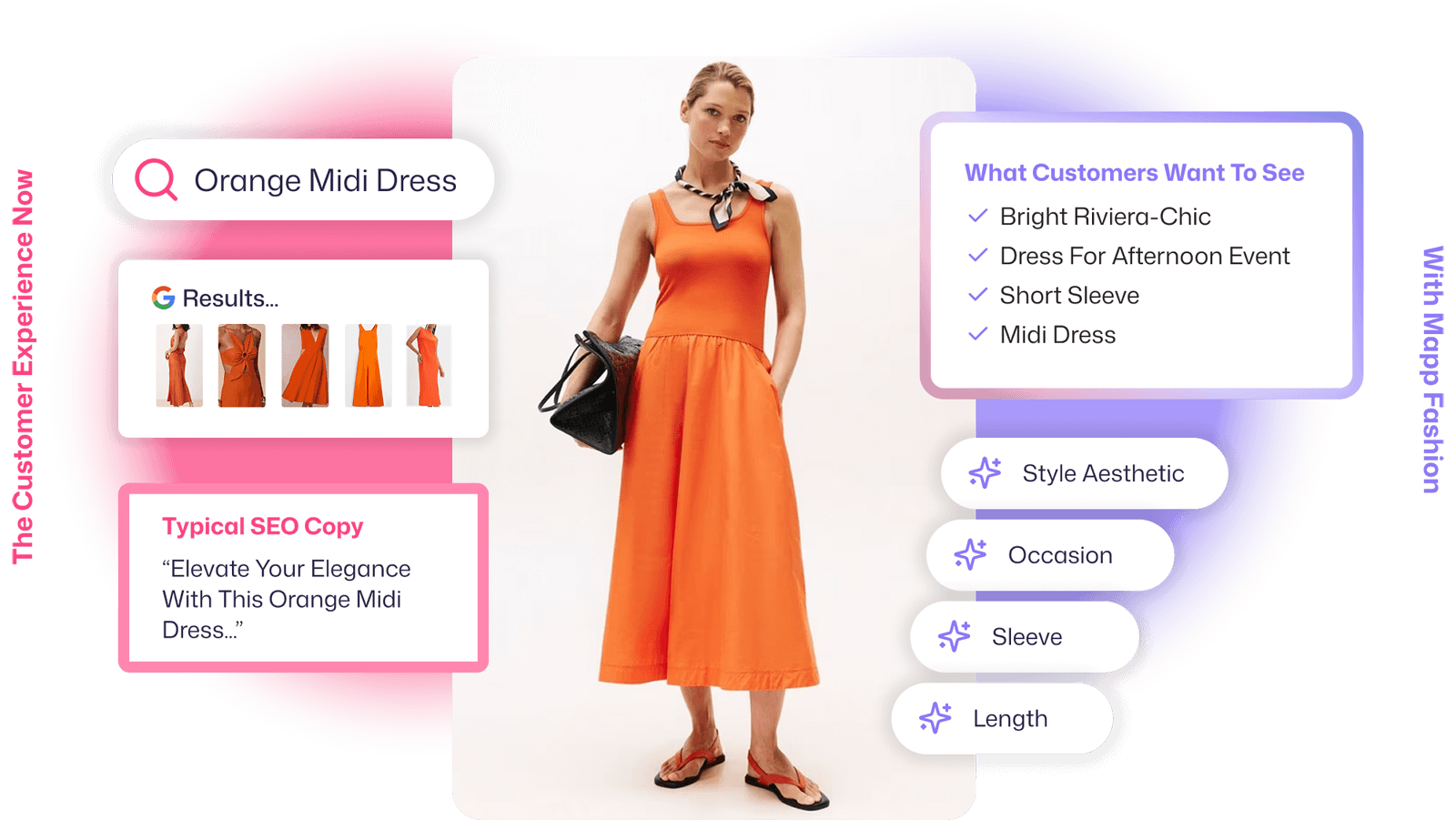
Google’s structured data guidance points to detailed product schema, consistent attributes, and clean metadata. In UCP-influenced environments, fragmented feeds and inconsistent descriptions create interpretability problems that directly affect how and whether products get surfaced.
Fashion retailers typically operate across multiple systems: merchandising tools, content management platforms, campaign systems, and paid media feeds. Each one can describe the same product differently. When those layers aren’t aligned, the result is ambiguity, and ambiguous products are less likely to be recommended accurately.
Structural clarity improves the odds that product information is interpreted consistently across AI-generated summaries and recommendations. Getting there requires cross-functional alignment, but the commercial case is increasingly hard to ignore.
Brand DNA defines the aesthetic and narrative foundation of a fashion label. It contains tone of voice, stylistic codes, cultural references, and design philosophy. It’s the strategic anchor that ensures coherence across collections, communication, and the wider customer experience.
In generative discovery systems, Brand DNA directly shapes how products get categorized and recommended. AI models interpret descriptive language to determine mood, formality, and context. When a brand’s language is generic or inconsistent, its distinct positioning becomes harder to detect and harder to surface in relevant scenarios.
Ann Taylor encountered this with generic personalization tools that relied on behavioral “people like you” logic rather than genuine product understanding. Mapp Fashion’s intent-led, feature-based recommender, built on deep, consistent product attributes spanning physical details, contextual signals, and trend data, outperformed two competing vendors in direct testing, including Salesforce Einstein. Gains were concentrated on high-intent PDP sessions where feature-level matching to suiting and workwear mattered most.
That’s Brand DNA embedded in data, doing commercial work.
Many fashion businesses maintain detailed internal taxonomies focused on material, fit, and construction. Marketing teams build campaign narratives around trends or seasonal themes. CRM systems segment audiences by behavior. Product feeds prioritize technical attributes for marketplace compliance. These layers often evolve independently of one another.
Generative systems rely on semantic coherence. When a shopper asks for “a modern but comfortable outfit for a business dinner,” the model evaluates cues related to occasion, mobility, and tone. If product descriptions focus only on fabric composition without addressing scenario or use case, the semantic signal stays incomplete, and a better-described competitor product fills the gap instead.
Preserving Brand DNA in an agentic environment requires integration across creative and technical layers. A few principles that make a real difference:
Contextualize products clearly. Descriptions that specify occasions or scenarios provide stronger signals for generative interpretation. Explicit occasion references consistently improved relevance in our AI recommendation analysis.
Align tone with intended use. Language associated with “cocktail,” “formal event,” or “business travel” communicates cultural and functional positioning. Tonal precision reinforces Brand DNA while improving interpretability.
Strengthen structured data. Comprehensive schema markup and consistent attribute naming help understand product information. Clean, unified feeds reduce ambiguity across systems, and as The House of Bruar demonstrated, the commercial upside of getting this right is significant.
Describe functional outcomes. Feature clusters like “machine washable,” “wrinkle-resistant,” and “breathable” collectively signal mobility and practicality. Describing what a garment enables, not just what it contains, gives AI systems more to work with.
Standardize language across channels. Consistency between PDPs, campaign messaging, and product feeds reinforces a cohesive identity and strengthens machine interpretation across every touchpoint.
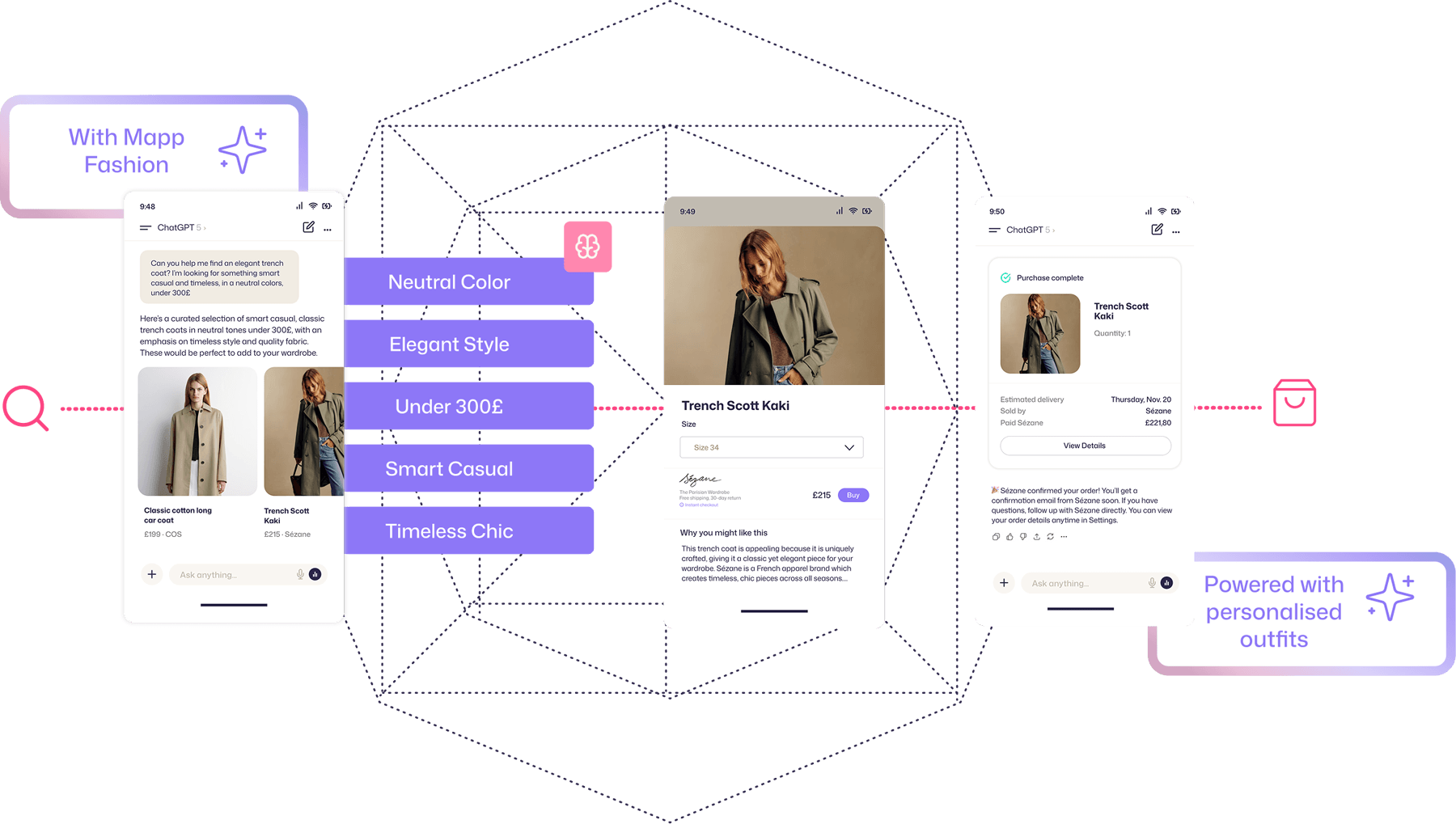
Agentic shopping and Google UCP represent a more interpretive model of discovery, one where visibility depends on how clearly and consistently products are described and structured.
The brands that adapt to this new reality will be better positioned to grow. Those that don’t are likely to find the gap widening, not because their products aren’t strong, but because their data isn’t working hard enough.
For fashion retailers, this means genuine collaboration between merchandising, marketing, data, and technical teams. Brand DNA needs to live in product attributes, schema, and feeds, not just in campaigns. Semantic precision becomes part of commercial strategy.
Brands that communicate their aesthetic and functional intent consistently across systems get accurately interpreted by generative engines. Those that don’t risk losing fidelity in the moments that matter most. Google UCP and agentic shopping reward preparation, alignment, and clarity. That’s exactly what Mapp Fashion is built to deliver.
Mapp Fashion’s product data enrichment solution combines fashion-native AI with a stylist QA loop, ensuring your catalog is enriched with the depth, accuracy, and brand consistency that generative engines need to surface your products in the right context.
Explore Mapp Fashion ›
We use a third party to perform the registration for our content. This third party may collect data about your activity. Please review the details and accept the service to complete the registration.